
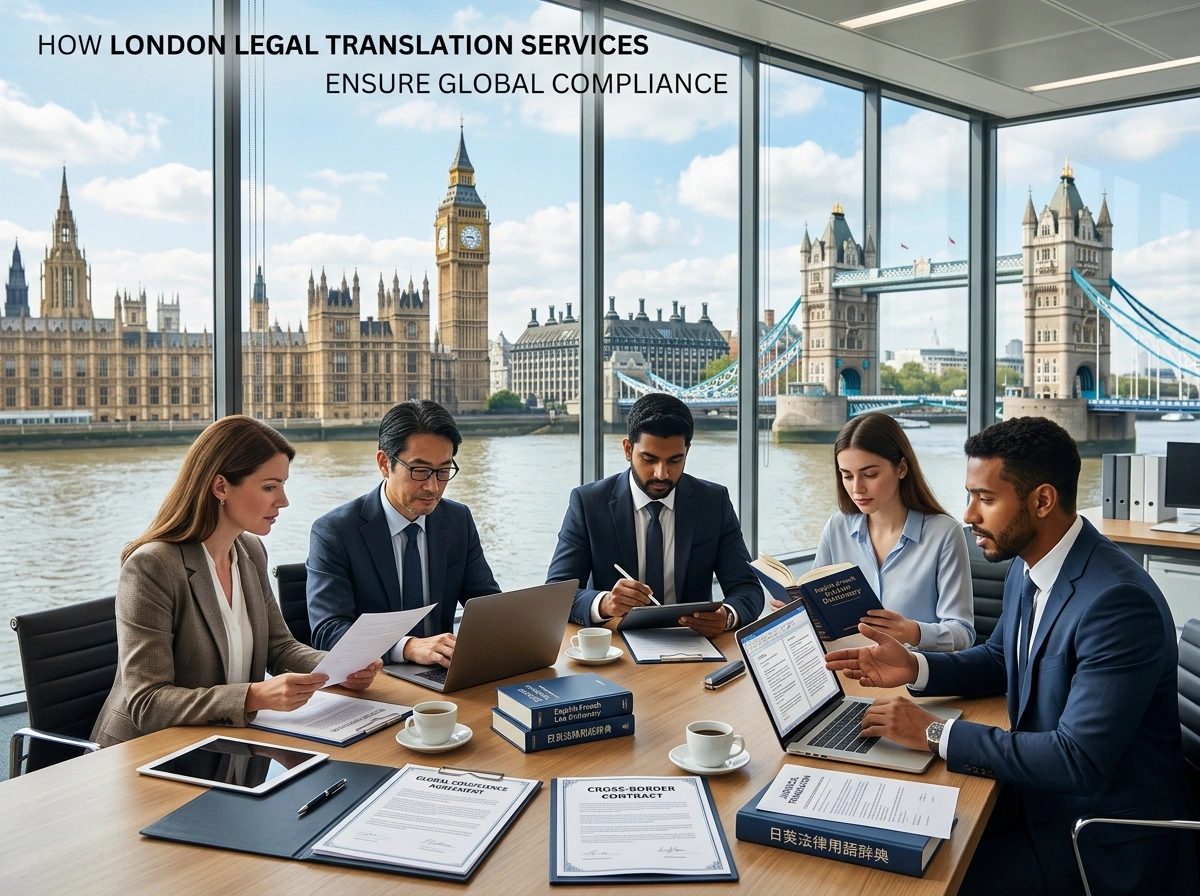
When businesses expand across borders or individuals navigate foreign immigration systems, language barriers become legal barriers. A minor mistranslation in a contract can cost millions. An incorrectly translated birth certificate can halt a visa application. Accurate legal translation acts as the bridge connecting different legal systems, ensuring smooth operations for international courts, multinational corporations, and private citizens.
This guide explores how professional linguists help organizations and individuals stay compliant with complex international laws. You will learn why accurate legal translation is critical, the specific challenges involved in translating legal documents, and how expert services in the UK capital manage these risks. By understanding the intersection of language and law, you can protect your global interests and avoid costly compliance failures.
The Role of London as a Global Legal Hub
London stands as one of the most important financial and legal capitals in the world. The city hosts the Royal Courts of Justice, the Old Bailey, and numerous international arbitration centers. As a result, businesses from across the globe choose English law to govern their international contracts.
Because of this international focus, the city boasts extraordinary linguistic diversity. Over 100 languages are spoken across its boroughs, creating a massive demand for multilingual legal support. Multinational corporations establish their headquarters here to tap into the European and global markets. Consequently, local law firms and courts constantly handle documents originally drafted in Polish, Arabic, Mandarin, Spanish, and dozens of other languages.
Operating in such a diverse environment means that legal professionals heavily rely on accurate translation to process evidence, review contracts, and manage cross-border disputes. Without precise translation, the legal machinery of this global hub would simply grind to a halt.
Navigating International Laws and Regulations
Operating internationally means dealing with a maze of regulations. A company exporting goods from the UK to the Middle East must comply with both local British regulations and the destination country’s trade laws. Every contract, compliance certificate, and shipping document must hold absolute legal validity in both jurisdictions.
International laws require absolute precision. If a business submits a financial disclosure to a foreign regulatory body, the translated document must reflect the exact financial reality of the original text. Regulatory bodies expect flawless documentation. Any ambiguity can trigger audits, legal penalties, or rejected applications.
Legal translators working in this space do much more than swap words between languages. They must understand the underlying legal concepts of both the source and target countries. A concept that exists in French civil law might not have a direct equivalent in English common law. The translator must find the correct legal equivalent to ensure the document retains its exact intended legal effect, thereby keeping the client fully compliant.
Ensuring Compliance Through Certified Translations
For official processes, standard translation is rarely enough. Government bodies, courts, and universities require a specific level of authentication. In the UK, institutions like the Home Office and UK Visas and Immigration (UKVI) demand certified translations for all foreign-language documents.
A certified translation includes a formal statement of accuracy, signed and stamped by a qualified professional. This certification guarantees that the translated document is a true and accurate representation of the original. Whether a client is submitting a marriage certificate for a spouse visa or presenting foreign evidence in an immigration tribunal, proper certification is a strict legal requirement.
Working with experienced legal translation services london provides peace of mind for law firms and private clients alike. These professionals know exactly what formats the UK courts and government agencies expect. By meeting these strict formatting and certification standards, they prevent applications from being delayed or rejected due to technicalities.
Challenges in Legal Translation for Global Jurisdictions
Translating legal documents involves unique hurdles that do not exist in standard translation. The primary challenge lies in the fundamental differences between legal systems. For instance, common law systems rely heavily on judicial precedents, while civil law systems depend entirely on codified statutes. A term perfectly understood by a British judge might confuse a German magistrate.
Another significant issue involves “false friends.” These are words in two languages that look similar but carry completely different meanings. In legal contexts, falling for a false friend can alter the entire meaning of a contract. Furthermore, formatting requirements vary wildly between jurisdictions. A power of attorney document in one country might require specific seals, while another country demands a completely different layout.
Confidentiality presents another major challenge. Legal documents often contain highly sensitive corporate secrets or personal data. Translators must adhere to strict data protection regulations, such as the GDPR, ensuring that all information remains secure throughout the translation process.
Technology and Human Expertise in Compliance
The translation industry has seen massive technological advancements in recent years. Artificial intelligence and machine translation tools can now process large volumes of text in seconds. During the discovery phase of a massive international lawsuit, law firms often use AI to quickly scan thousands of foreign-language emails to identify relevant information.
However, technology cannot replace human expertise in legal translation. AI lacks the ability to understand nuanced legal contexts or adapt to the subtle differences between international legal systems. Machine translation might translate a contract literally, creating a document that makes grammatical sense but holds no legal weight.
The most successful compliance strategies use a hybrid approach. Technology handles the initial processing and speeds up the workflow, while expert human linguists review, refine, and certify the final text. This combination ensures maximum efficiency without compromising the rigorous accuracy required for international legal compliance.
Examples of Legal Compliance Success
Proper legal translation directly enables global business success and personal mobility. Consider a multinational merger between a UK-based corporation and a Japanese tech firm. The due diligence process requires reviewing decades of corporate governance documents, employee contracts, and financial records. By utilizing specialized legal translators, both legal teams can accurately assess liabilities and finalize the merger without compliance violations.
Another common scenario involves international employment. When a London hospital hires medical professionals from overseas, the candidates must submit their academic transcripts and police certificates. Accurate, certified translations of these documents allow the General Medical Council to verify their qualifications swiftly. This keeps the hospital compliant with strict hiring regulations and allows the doctors to begin their vital work without unnecessary delays.
These scenarios demonstrate how accurate translation serves as the foundation for successful international interactions. When the language is handled correctly, organizations can navigate global jurisdictions with total confidence.
Choosing the Right Legal Translation Service in London
Selecting the appropriate translation partner requires careful consideration. Organizations should look for agencies that specialize exclusively in legal translation. The translators should hold recognized linguistic qualifications and possess a deep understanding of the relevant legal systems.
Always ask about security protocols. A reputable service will have strict non-disclosure agreements and secure file transfer systems in place to protect sensitive data. Additionally, ensure the provider has a strong track record of producing translations accepted by major UK institutions, such as the Home Office and the Royal Courts of Justice.
Securing Your Global Legal Strategy
Legal translation is an indispensable part of international business and immigration. As globalization continues to connect different legal jurisdictions, the need for flawless, legally binding communication will only grow. By prioritizing accuracy and working with certified professionals, you safeguard your operations against compliance failures and legal disputes.
Take the time to evaluate your current translation processes. If you regularly handle cross-border contracts or international applications, partnering with a specialized legal translation service is one of the smartest investments you can make. Protect your legal rights, maintain regulatory compliance, and ensure your global strategy rests on a foundation of absolute clarity.
